
Storage systems | Noega Systems
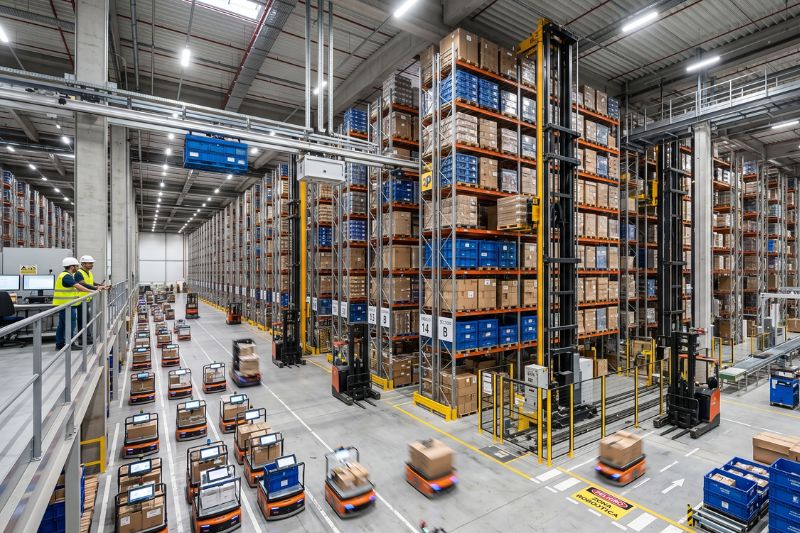
In a large warehouse, every technical decision has a multiplier effect. A design mistake that would mean a minor inefficiency in a conventional installation can, in a large-scale warehouse with tens of thousands of SKUs and continuous flows of goods, translate into quantifiable operational losses and structural risks that compromise the safety of the entire facility.
This analysis identifies the most common critical mistakes in large warehouses and the proven technical solutions for each of them.
Layout design in large warehouses, the source of most inefficiencies
In a large warehouse, the layout is not an initial drawing that gets filed away after commissioning. It is the variable that shapes the entire operational chain: inbound and outbound flows, picking times, sizing of the handling fleet and real storage capacity. When the layout of a large-scale warehouse has not been recalculated after significant changes in order volume or SKU profile, the consequences are measurable, redundant picking routes, congestion at the loading docks and underuse of the available volume that can reach 30%.
Diagnosis of common mistakes in large warehouses
The following table summarises the mistakes most frequently detected in audits of large warehouses and high-capacity logistics centres:
| Mistake identified | Operational impact | Classification | Corrective action |
|---|---|---|---|
| Oversized aisles | Up to 25% reduction in usable capacity | Efficiency | Conversion to very narrow aisles (VNA) |
| No annual ITE inspection | Risk of undetected structural collapse | Critical safety | Certified technical inspection according to UNE-EN 15635 |
| Incompatibility between systems | Crossing flows, idle times and bottlenecks | Efficiency | System compatibility audit |
| Unrecorded impacts on uprights | Progressive loss of load-bearing capacity | Critical safety | Reporting protocol and passive protections |
Structural overload in large-scale warehouses
In large warehouses where the pressure to maximise occupancy is constant, racking overload becomes a systemic risk. The rated load capacity of each level and bay is determined by the manufacturer’s structural calculations and does not allow for arbitrary operating margins. When the actual load configuration does not match the one specified on the load notices, the integrity of the entire large warehouse installation is compromised.
How can racking overload be detected in a large warehouse?
The technical indicators that should trigger immediate action in a large warehouse are plastic deformation of beams, visible buckling of uprights, displacement of beam-to-frame connectors and the appearance of micro-cracking at weld points. Any of these signs indicates that the structure is operating outside its design parameters. If, in addition, the load notice is not visible or does not reflect the current load configuration per level, a Racking Technical Inspection in accordance with the UNE-EN 15635 standard must be carried out without delay.
Which protections are mandatory on racking in a large-scale warehouse?
The UNE-EN 15635 standard sets out specific passive protection requirements for every storage installation, which are especially relevant in large warehouses with heavy handling equipment traffic. Upright and frame protectors are mandatory to absorb impacts and prevent direct damage to the load-bearing structure. Anti-collapse mesh must be installed in pedestrian aisles to prevent objects from falling from upper levels. Pallet stops ensure that the load unit does not protrude beyond its assigned level. All of these protection elements require periodic checks and immediate replacement after any significant impact. In a large-scale warehouse, where manoeuvres are far more frequent, these inspection cycles must be shortened accordingly.
When is it profitable to automate a large logistics warehouse?
The decision to automate a large warehouse should be based on a return analysis, not on a trend. The factors that justify the investment are storage heights above 12-15 metres (where manual operations lose efficiency exponentially), high and repetitive operating volumes, the need to operate in controlled environments such as sub-zero temperature rooms, and an accumulated labour cost that exceeds the payback of the automated system. Under the right conditions, a correctly sized automated large warehouse triples storage capacity compared with a conventional solution on the same building footprint.
Technical prevention as a competitive advantage in large warehouses
In large-scale warehouses, leaving mistakes uncorrected is not caution, it is a cumulative cost with operational and legal consequences. Periodic layout reviews, rigorous compliance with racking safety regulations and an objective technical assessment of automation options are the three levers that set an efficient large warehouse apart from one operating below its potential.
Do you need to audit or redesign your large warehouse?
At Noega Systems we design, manufacture and install industrial racking and storage systems for large warehouses and high-capacity logistics centres. We carry out the ITE® Racking Technical Inspection in accordance with the UNE-EN 15635 standard. Contact our technical department on 984 190 927, at infoweb@noegasystems.com or via noegasystems.com/contacto.


