
Large warehouses | Noega Systems
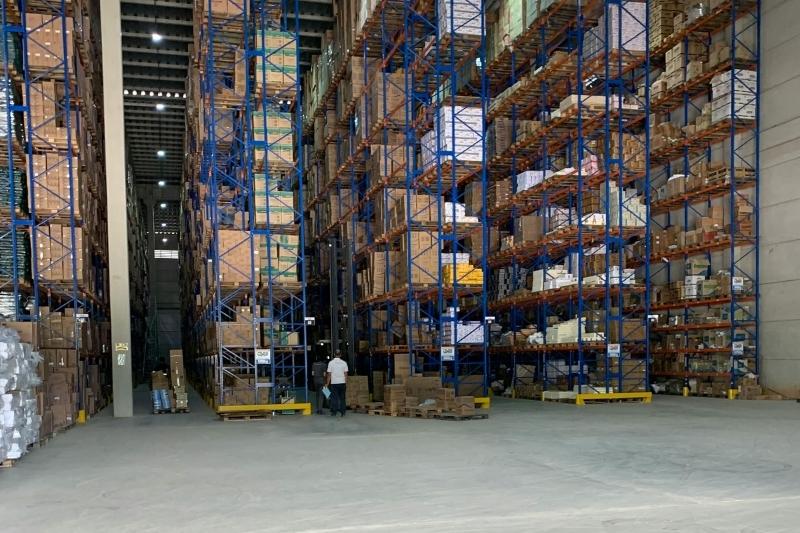
When a warehouse starts operating, most of its performance has already been written. Large warehouses stake their efficiency and safety on a handful of decisions made months before the first pallet arrives, the layout, the height, the storage system and the loads it will handle. None of them can be corrected later without a cost.
Layout comes first
A layout mistake cannot be fixed with more staff or more forklifts, it drags on throughout the entire service life of the warehouse. Poorly sized aisles and crossing flows create unproductive journeys that multiply with every daily operation. What looks like a two-metre difference on the drawing becomes thousands of trips a year in operation.
The layout is defined before almost everything else because it conditions the rest, aisle width determines which forklift can operate, the forklift determines the achievable lift height and that height determines how many levels fit.
Growing vertically
Growth is sought in height, not in floor area. Extending the building means land, permits and construction; expanding vertically means making use of a volume that is already paid for and that, in many facilities, goes unused above the top level.
Self-supporting systems take that logic to the extreme, the racking structure itself acts as the skeleton of the building and supports the roof and cladding, so there are no two structures being paid for separately. They allow heights that a conventional building cannot reach and optimise loads, weights and stored volume from the very first calculation. But it is a project decision, not a later upgrade, a self-supporting system cannot be installed in an existing building.
The decisions that shape the entire service life
The difference between an upfront decision and a later correction is rarely a matter of nuance. This is the honest picture of what it costs to rectify each of them:
| Decision | When it is made | What it costs to correct it later |
|---|---|---|
| General layout and flows | Before the building is defined | Relocating racking and redoing traffic routes, with operations halted |
| Aisle width and handling equipment | During layout design | Changing forklifts or giving up storage positions |
| Height and vertical use of space | In the structural design | Unfeasible without replacing the entire installation |
| Storage system (conventional, compact, self-supporting, automated) | Before the load calculation | Complete redesign of the warehouse |
| Load unit and permissible loads | Before the structural calculation | Recalculation, reinforcements or permanent capacity limitation |
| Protections and maintenance plan | In the installation design | Later add-ons, more expensive and less effective |
View this post on Instagram
The most common mistake, deciding piece by piece
In high-volume facilities, the usual failure is not choosing the wrong component, but choosing each component separately. The building is contracted on one side, the racking on another and the handling equipment on a third, and each supplier optimises its own part without seeing the whole. The result is a warehouse that works, but never performs as it should.
Safety follows the same pattern. A facility that is properly sized and protected from the design stage reaches the racking inspection with normal wear and tear. A poorly sized one arrives with structural damage that forces bays to be unloaded and blocked off, and that is lost capacity too.
Storage engineering from start to finish
Designing large warehouses is a chain of interlinked decisions, not a product catalogue. Loads, heights, flows, equipment, regulations and maintenance form a single system, and each link conditions the next.
At Noega Systems we handle the complete project, needs analysis, structural calculation, definition of the storage system, installation, training and subsequent inspection. From start to finish, because it is the only way for upfront decisions to hold up once the warehouse is operating. Contact our technical engineering team today by calling 984 190 927, email us at infoweb@noegasystems.com or fill in the form at noegasystems.com/contacto to receive a tailored study.


