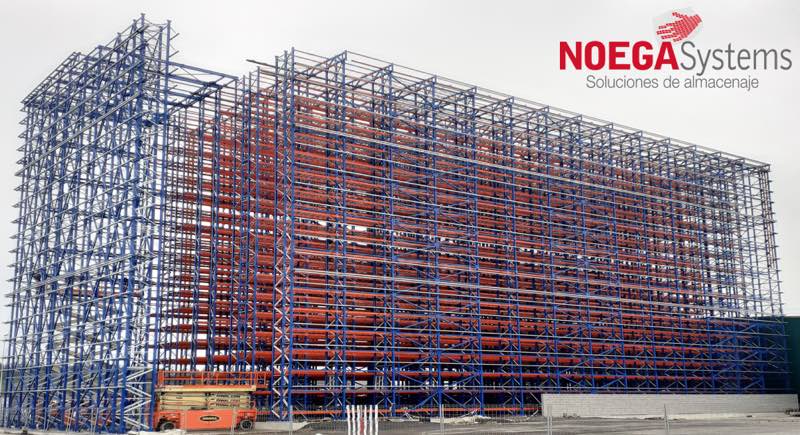

Space optimization in industrial storage | Industrial storage
In industrial storage, “we need more space” almost never means just “we need more square meters.” Most of the time, it means the warehouse is operating with a layout that no longer fits current operations: SKUs have grown, rotations have changed, order picking has become more demanding, or inflow and outflow peaks have increased.
The good news is that before considering expanding the warehouse or moving facilities, there is usually room to gain capacity and fluidity through technical decisions: reorganization, system selection, aisle adjustments, staging areas, and, above all, integrated safety so that the change doesn’t result in more collisions and breakdowns.
The most common mistake is optimizing only for “slots”
Optimizing space isn’t about cramming in more pallets at any cost. If you narrow aisles too much, create dangerous intersections, or reduce maneuvering areas to gain capacity, what you gain in slots, you lose in:
- Impacts on uprights and frames.
- Downtime due to incidents and complicated replenishments.
- Time lost to poorly designed routes and blockages.
- Risk due to overloading or incorrect system use.
Quick diagnosis: where is your space going?
These are the typical capacity “leaks” in industrial storage:
- Uncontrolled staging (receiving/shipping occupying aisles and slots).
- Misplaced reserve stock (palletizing mixed with picking without criteria).
- Poorly assigned rotation: fast-moving items in slow zones (or vice versa).
- Oversized aisles for the actual equipment (or poorly planned for the equipment used).
- Wasted height due to a conservative initial design or lack of adaptation.
Actions that typically yield the highest return (without complicating operations)
Reorder by rotation (ABC) and proximity
Placing the highest-turnover items in quick-access zones reduces travel distances and frees up “dead” space caused by unnecessary searching and movements.
Clearly separate zones: receiving, staging, picking, reserve, and shipping
When everything is mixed together, the warehouse looks “full” even when it isn’t: what’s actually full is the aisle. Defining and protocolizing each zone is usually one of the fastest improvements.
Combine picking + reserve at height
A very common practice: picking at the bottom for accessibility and reserve at the top for capacity. This organizes replenishment and reduces aisle encroachment.
Aisles and equipment: adjust to reality
Sometimes the layout isn’t designed for the equipment actually being used today. Adjusting aisles to turning radiuses, crossing zones, and visibility points reduces impacts and allows for meter optimization without increasing risk.
View this post on Instagram
Optimization strategies (when they are suitable and what to watch out for)
| Strategy | When it is suitable | What it provides | What to watch out for |
|---|---|---|---|
| ABC Reordering | Many SKUs and uneven rotation | Fewer routes, higher speed | Update ABC by season |
| Picking + Reserve | Preparation by case/unit | Order and efficient replenishment | Clear replenishment rules |
| More levels at height | Available height and suitable structure | More capacity without expansion | Capacities, anchors, and safety |
| Channel compaction | Few references with high volume | High density | Maneuvering and protections |
| Staging redesign | Receiving/shipping peaks | Prevents blockages and chaos | Delimitation and discipline |
| Protections at critical points | Repeated impacts | Fewer damages and downtime | Choosing the right protection |
Optimization without safety is a false saving
When you gain density, maneuvering requirements increase. Therefore, any industrial storage optimization should include:
- Protections on uprights and frames where traffic is most intense.
- Signage for flows, priorities, and safety zones.
- Load plaques that are visible and consistent with actual use.
- Training to standardize maneuvers, replenishment, and incident reaction.
How to know if the optimization is working
Don’t measure it only by “free slots.” Measure it by:
- Preparation time (lines/hour or orders/hour).
- Incidents (impacts, damage, blockages, relocations).
- Aisle occupancy (pallets out of place).
- Downtime due to maintenance or component replacement.
Frequently Asked Questions
How can I gain space without changing the whole system?
Usually by reordering by rotation, delimiting staging, separating picking and reserve, and correcting routes. These changes typically free up meters and improve times without major investments.
When does it make sense to switch to a more compact system?
When you have high-volume references and need density. If you have many SKUs and need direct access, a high-density system can penalize operations.
Is increasing levels at height always viable?
Not always. It depends on usable height, sprinklers, internal regulations, system capacities, and equipment. Before modifying, it is advisable to validate technically to ensure stability and safety.
What improvement most quickly reduces impacts in the warehouse?
Protections at critical points + signage and traffic rules. If you also improve visibility at crossings and order in staging, the reduction is usually significant.
If you are considering redesigning your warehouse or setting up a new one and want to know exactly how much capacity you need, at Noega Systems, storage systems, we can help you put clear figures and plans on the table before you outgrow your space in two years. Contact us.